darkfolio
Track everything. Reveal nothing.
A portfolio tracker that can't know what you own.

Free for 14 days. No account needed.
A portfolio tracker that can't know what you own.
Free for 14 days. No account needed.
Most track what you own. Some promise they don't.
Every user gets identical data — all 7,000+ prices, every time. Your device extracts what it needs locally. We couldn't tell what you own if we wanted to — and you can verify it yourself.
No accounts. No analytics. No telemetry. Just the same universal price requests from everyone.
Your portfolio and watchlist. One glance.
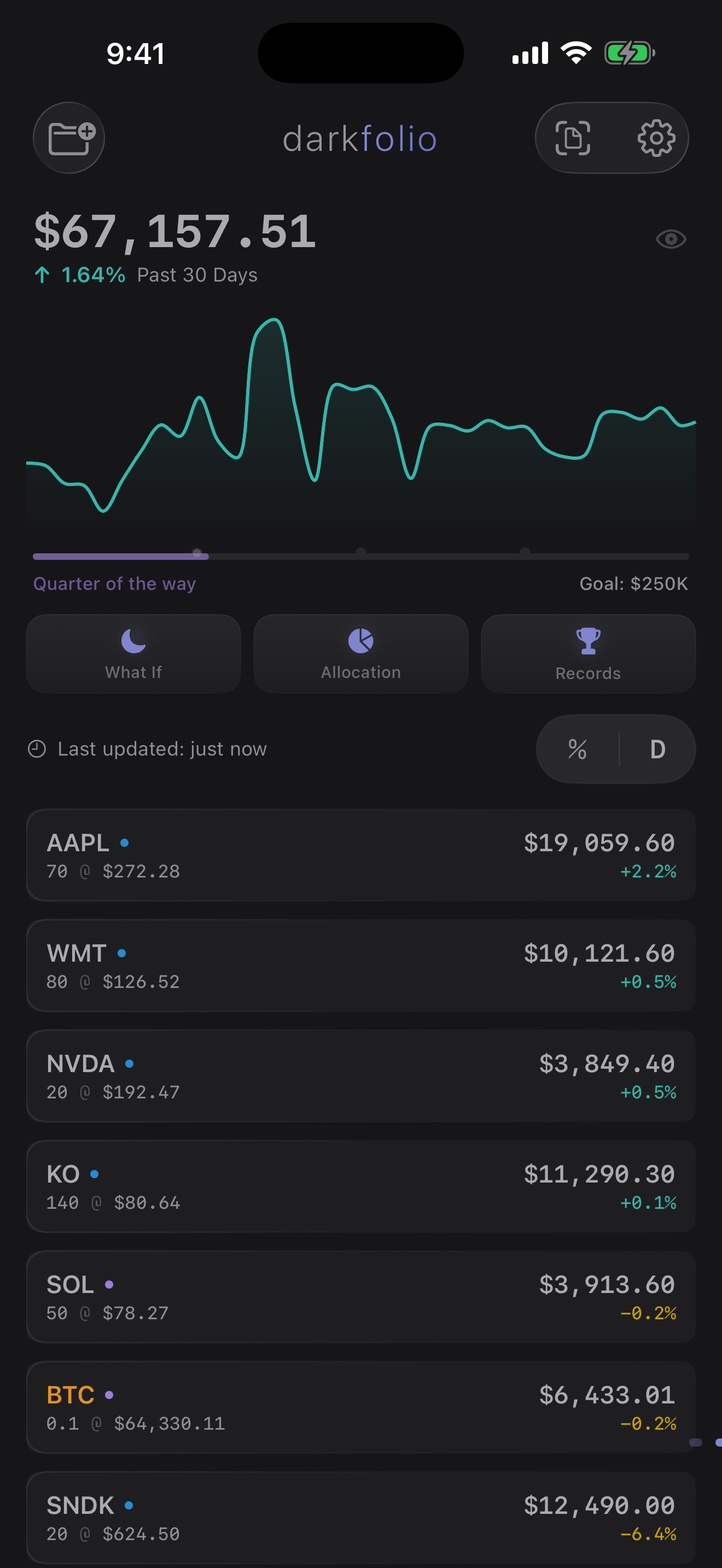
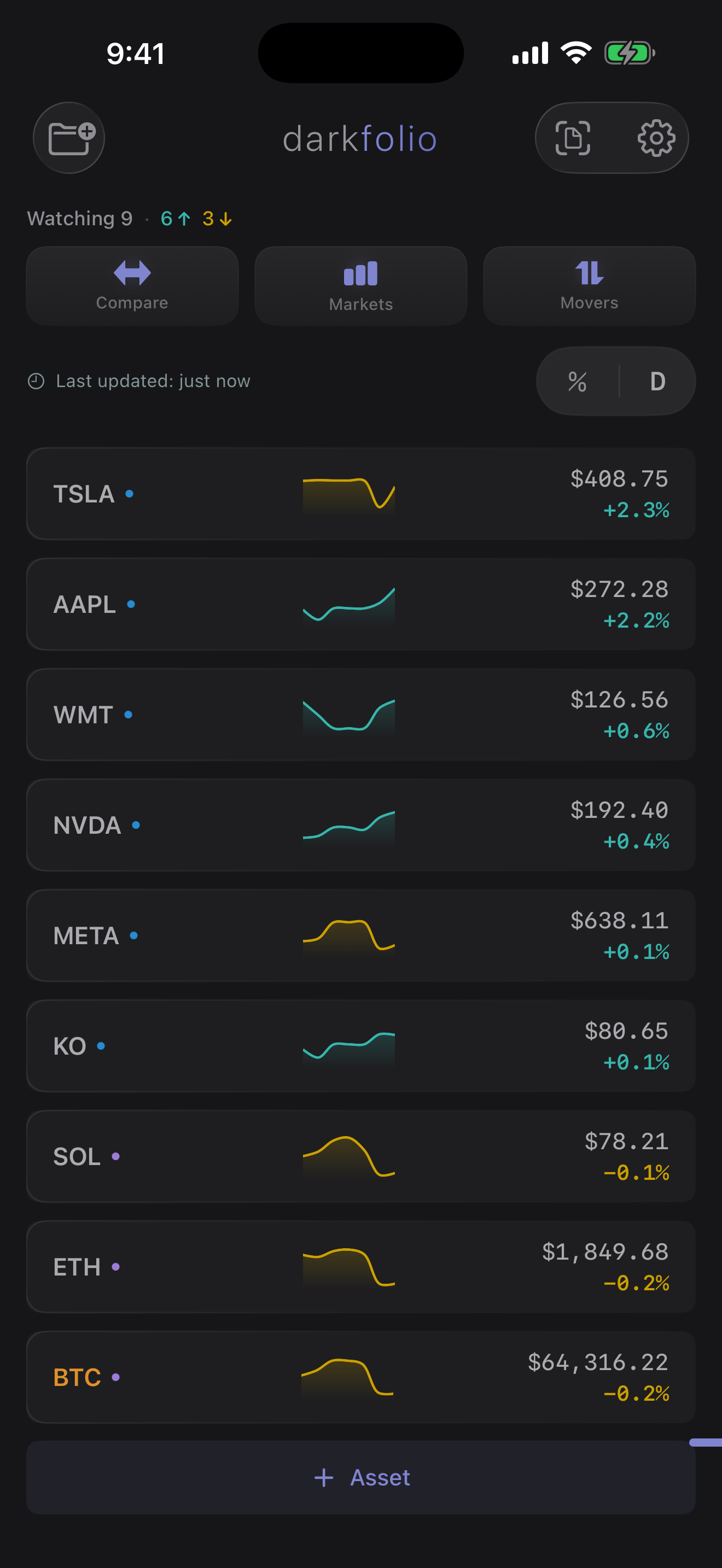
Stretch prices. Swap market caps.
Stretch prices.
Swap market caps.
All on your device. Nothing shared.
We don't monetize your data. We can't. So no ads, no dark patterns. Just useful features.
Blind pricing hides what you own. Tor hides that it's you.
Built-in Tor client. Not a proxy. Not a VPN. Real onion routing, inside the app.
Every privacy app makes promises. We give you proof.
Every refresh downloads every price — all 7,000+ assets, not just yours. The server sends identical data to everyone, so it has no way to know what you hold. Use a network inspection tool like Proxyman (free) to see every request the app makes — and confirm there's nothing hidden.
With Tor enabled, our server has no idea who's asking for prices — not your identity, not your location, nothing. Re-enable Tor and check your network inspector: our domains disappear entirely. Tor routes traffic outside the normal network stack, so the inspector can't see it — and neither can your ISP.
The app walks you through it in Settings › Verify. Or read the full verification guide.
Two PINs, two separate spaces — each with its own holdings and watchlists. From the outside, the app looks exactly the same either way.
Both spaces are built into every install — same encryption, same size on disk. Useful for shared devices, keeping investments separate, or simply peace of mind.
Two spaces. One app.
One tap hides all amounts held — values, quantities, everything personal. One tap brings them back. Coffee shop, shared screen, nosy coworker — covered.
Free for 14 days. No account, no email, no sign-up.
Screenshot import or add manually. Takes 30 seconds.
Verifiably. No trust required.
Check your holdings anywhere — on the train, at the office, on someone else's Wi-Fi. Not even we can see what's on your screen.
Nothing to sell. Nothing to leak. Nothing to hand over.
Try free for 14 days.
Then $9.99/month, $59.99/year, or $149.99 for life.
Over 7,000 assets: roughly 3,300 NASDAQ stocks, 2,700 NYSE stocks, 200 AMEX stocks, and 350+ cryptocurrencies. If it's publicly traded on a major US exchange or a top cryptocurrency, it's there.
Yes. Take a screenshot of any brokerage or portfolio app, and Darkfolio's on-device OCR will detect the ticker symbols — works for both portfolios and watchlists. The image is processed in memory and never saved. You add quantities manually.
None. No accounts, no analytics, no crash reporting, no telemetry. Your portfolios are encrypted on your device and never leave it.
Your data is never deleted. The free tier keeps one portfolio with unlimited holdings, one watchlist with unlimited assets, all 25 currencies, and price alerts. Excess portfolios and watchlists are deactivated, not removed.
If you set up Ghost Mode during your trial, both vaults stay encrypted on your device and your PINs are preserved. The second PIN just stops working until you subscribe. Upgrade to Pro and Ghost Mode is immediately active again — same PINs, same vaults.
Pro unlocks: Ghost Mode, Tor routing, What-If scenarios, Compare, screenshot import, and unlimited portfolios and watchlists.
Upgrade anytime and it all comes back.
App Lock is available to everyone — it's a single PIN that protects your app. Ghost Mode, available to Pro users, adds a second PIN that opens a completely separate portfolio in its own encrypted vault. Enter the second PIN and check Settings: App Lock is on, Ghost Mode is right there but shows as off. Even someone who knows the app has Ghost Mode can't tell it's active. That's the point — it doesn't just protect your data. It hides that there's anything to protect.
You can even turn App Lock off from inside the second PIN's space, so the app opens freely with no lock at all. Turn it back on later, enter your first PIN, and your original space is right where you left it.
Every Darkfolio installation has two encrypted vaults — that's just how the app is built, whether or not you use Ghost Mode. Both vaults have the same file structure, the same encryption, the same size on disk. File names are neutral. Keychain entries exist for both PINs on every device. Security metadata is itself encrypted. Nothing labels one vault "real" and the other "secondary." That distinction exists only in your mind.
No security measure is absolute. Ghost Mode is designed to raise the bar significantly for anyone trying to determine what you own — or whether you're using the feature at all. More details are in the privacy policy.
Face ID can't open two different vaults — our users aren't two-faced. Beyond that, there's an evolving legal distinction in some jurisdictions between biometrics (often treated as physical evidence) and memorized PINs (which may be considered testimonial). The law varies by country and is still being tested in courts. We're not lawyers and this isn't legal advice, but it's one of the reasons we chose PINs. Biometrics are convenient. PINs may offer different protections.
The trade-off: if you forget your PIN, your data is gone. No recovery, no "forgot PIN" email, no backdoor. If we could recover it, so could someone else. After 5 wrong attempts, the app can be configured to wipe everything automatically.
No. Your encrypted vaults are stored on-device with iOS Keychain protection marked "this device only" — they're excluded from iCloud and iTunes backups. If you lose your phone, your data is gone. That's the trade-off.
Widgets use unencrypted shared storage. A price widget would bypass the blind pricing proxy, revealing exactly which assets you track. Watch apps have the same problem. We chose privacy over convenience — if you want to see prices, open the app behind your PIN.
Don't trust, verify. Use a network inspection tool like Proxyman (free on the App Store) to see every request Darkfolio makes. You'll see only price domains, identical responses for every user, and zero information about your holdings sent. Settings › Verify walks you through it step by step.
Your portfolio data lives on your device, not our servers. If we disappeared tomorrow, your encrypted vaults, holdings, and records would still be right where you left them. Prices would stop refreshing — that's the only thing that requires our server. Your data is yours.
Not yet. iOS only for now. We want to get one platform right before expanding. Requires iOS 18.0 or later.